SEO content writing vs SEO copywriting is a distinction that determines how your content performs at different stages of the buyer journey. Most SaaS teams ask whether to invest in SEO content writing or SEO copywriting for conversions.
The answer is both, but at different stages. SEO content writing builds authority and long-term traffic. SEO copywriting drives transactional conversions. The right mix depends on funnel stage and search intent.
This guide breaks down the intent differences, conversion benchmarks, and a practical framework for combining both disciplines.
This is part of our ultimate guide on content marketing vs SEO vs copywriting vs content writing.
About the author: This guide was written by Amir Ali, an SEO content writer and conversion copywriter with four years of experience serving B2B and e-commerce clients across the USA and UAE markets. He has built 180,000 monthly organic visitors for a single e-commerce brand and published 500+ pieces across six industries. He is HubSpot Content Marketing Certified and founder of Clienvora.
Definitions and Overlap
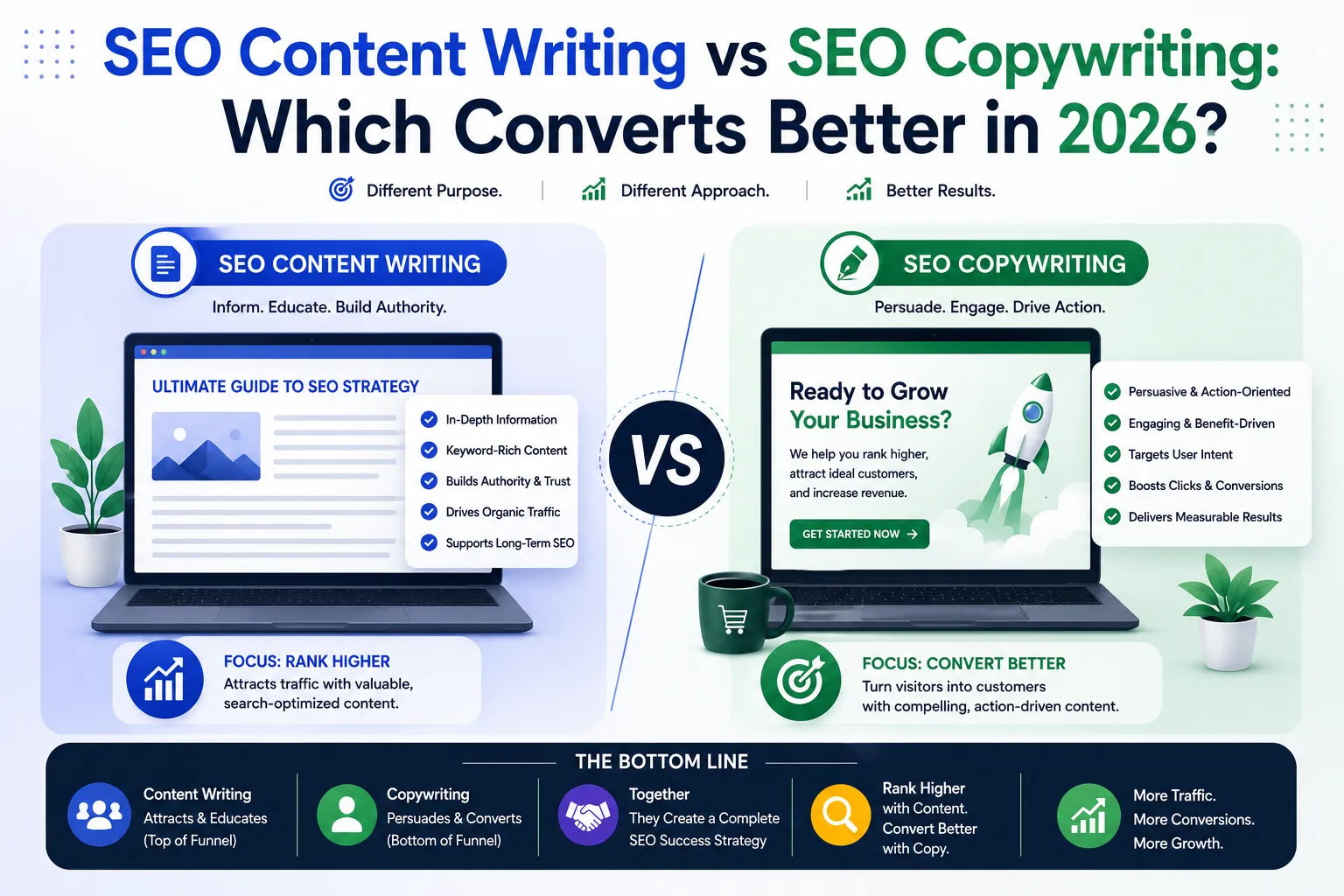
SEO content writing: Long-form, informational, authority-building content optimized for search engines. Pillar posts, guides, how-tos, and comparison articles. The goal is traffic and topical authority.
SEO copywriting: Conversion-focused, transactional writing optimized for search engines. Landing pages, product pages, CTAs, and demo request pages. The goal is a specific action.
Overlap: Both use keyword research, on-page SEO, and structured content. The difference is objective: traffic versus transactions.
| Dimension | SEO Content Writing | SEO Copywriting |
|---|
| Primary objective | Traffic and authority | Conversions and revenue |
| Search intent targeted | Informational, Commercial | Transactional, Commercial |
| Typical format | Blog posts, pillar guides, how-tos | Landing pages, pricing pages, CTAs |
| Conversion benchmark | 0.5-2% (blog to trial/demo) | 2-8%+ (landing page to trial/demo) |
| Time to conversion | Weeks to months | Immediate to days |
| Success metric | Organic sessions, rankings | Conversion rate, revenue |
The core difference comes down to search intent. Different intents require different formats.
| Intent | User Goal | Best Format | Lead Discipline |
|---|
| Informational | ”How do I improve onboarding?” | Long-form guide | SEO content writing |
| Transactional | ”Buy onboarding tool” | Landing page with CTA | SEO copywriting |
| Commercial investigation | ”Best onboarding tools for startups” | Comparison page | Both |
| Navigational | ”Userflow login” | Minimal page | Neither |
Writing a landing page for an informational keyword is wasted effort. The visitor wants education, not a sales pitch. Writing a blog post for a transactional keyword is equally wasteful. The visitor wants to buy, not to learn.
Conversion Rate Benchmarks (2026 SaaS Data)
| Page Type | Median Conversion Rate | Top Performers |
|---|
| Blog post CTA to trial | 0.5-2% | 2-4% |
| Gated content CTA (ebook, checklist) | 1-4% | 5-8% |
| Landing page to trial signup | 2-5% | 8-12% |
| Demo request page | 3-8% | 12-20% |
| Pricing page to purchase | 1-3% | 4-7% |
Blog CTAs convert at lower rates because the visitor is in research mode. Landing pages convert at higher rates because the visitor has transactional intent. The goal is not to make blog CTAs match landing page conversion rates. The goal is to match the format to the intent.
A/B Test Examples
Landing page headline test:
| Variant | Headline | Conversion Rate |
|---|
| A | ”Feature-rich project management software” | 2.1% |
| B | ”Ship projects 40% faster. Your first month free.” | 3.5% |
Benefit-focused headlines with specific numbers outperformed feature-focused headlines by 67%.
Blog CTA placement test:
| Variant | CTA Placement | Click-through Rate |
|---|
| A | Single CTA at end of post | 0.8% |
| B | Inline CTA after key section + end CTA | 2.1% |
Multiple CTAs at natural stopping points increased blog-to-trial clicks by 162%.
CTA copy test:
| Variant | CTA Text | Click-through Rate |
|---|
| A | ”Start free trial” | 1.8% |
| B | ”Get instant access. See how it works.” | 2.5% |
Action-oriented copy with outcome language outperformed standard CTA text by 39%.
When to Use SEO Content Writing in Your Funnel
Top of funnel (TOFU):
Awareness and educational content. Pillar posts, how-tos, and industry guides. The goal is organic traffic and building authority.
Middle of funnel (MOFU):
Comparison guides, case studies, and in-depth tutorials. The goal is nurturing leads toward a decision.
KPIs: Organic sessions, backlinks, time on page, newsletter signups.
Example: A guide titled “How to Improve User Onboarding” targets informational intent. It includes a contextual CTA for the product but does not lead with it.
When to Use SEO Copywriting in Your Funnel
Bottom of funnel (BOFU):
Landing pages, product pages, pricing pages, and demo request pages. The goal is driving trials, demos, and purchases.
KPIs: Conversion rate, click-through rate, revenue attribution.
Example: A landing page titled “Onboarding Software for SaaS Teams” targets transactional intent. The headline states the outcome. The CTA is prominent above the fold.
The Funnel Framework
| Funnel Stage | Format | Intent | Writer Type |
|---|
| TOFU | Blog post, pillar guide | Informational | Content writer |
| MOFU | Case study, comparison | Commercial | Content writer + Copywriter |
| BOFU | Landing page, pricing | Transactional | Copywriter |
| Retention | Email sequence, newsletter | Existing customer | Copywriter |
Common Mistakes
Using content writing for transactional pages. Writing a 2,000-word educational blog post for a transactional keyword like “buy CRM software.” The visitor wants a product page, not a lesson.
Using copywriting for informational pages. Writing a landing page for an informational keyword like “what is CRM.” The visitor wants an explanation, not a sales pitch.
No A/B testing on landing pages. Most teams launch a landing page and never test it. A/B testing headlines, CTAs, and social proof placement can improve conversion rates by 20-50%.
Weak CTAs on blog posts. A single “learn more” link at the end of a pillar post leaves conversions on the table. Inline CTAs at natural stopping points capture readers when they are most engaged.
Checklist: Choosing the Right Format for Each Page
FAQ
Can SEO content writing and SEO copywriting exist on the same page?
Yes. A well-structured pillar page can include educational content (content writing) and contextual CTAs (copywriting). The ratio should match the intent.
Which converts at a higher rate?
SEO copywriting converts at higher rates per visitor because it targets transactional intent. SEO content writing converts at lower rates per visitor but attracts more total visitors.
Do I need separate writers for each?
Ideally, yes. The skill sets overlap but the objectives differ. A content writer who thinks in terms of traffic and authority may struggle with conversion-focused copy.
Not sure which format fits your funnel? Contact Clienvora for a free funnel audit. We map your content to the right intent and format.
This guide was written by Amir Ali, founder of Clienvora. With four years of experience in SEO content writing and conversion copywriting for B2B and e-commerce clients across the USA and UAE, he has built 180K monthly organic visitors for a single brand and published 500+ pieces across six industries. Connect on LinkedIn or view his portfolio.