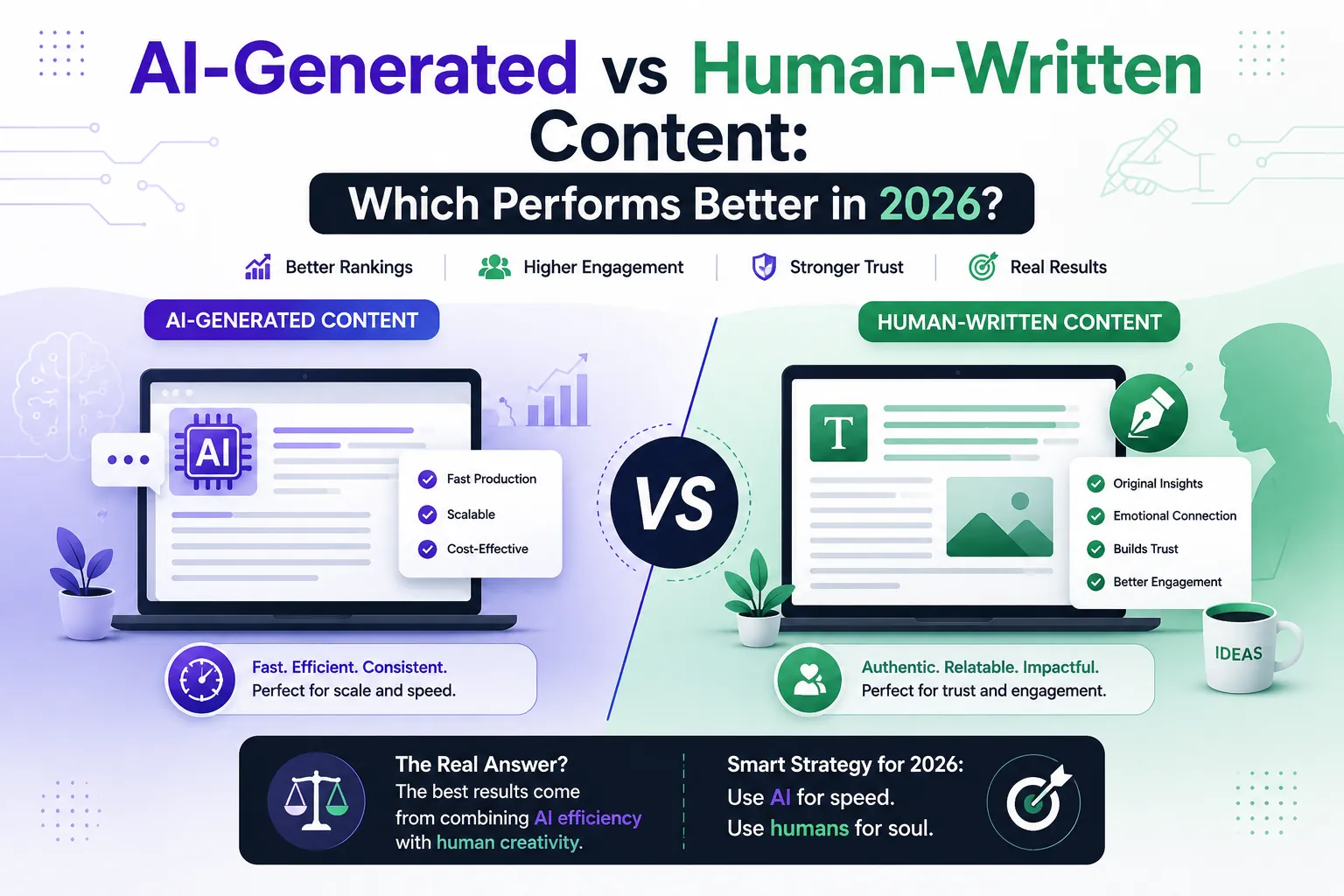
AI-generated vs human-written content is a decision that directly affects your content’s long-term ranking potential and cost structure. AI can write 10 blog posts in the time it takes a human to write one. That speed advantage has convinced many B2B teams to scale content production with AI-generated drafts.
The data on whether that content actually performs tells a different story. AI-generated content ranks in the short term. It rarely sustains those rankings beyond 90 days. Human-written content takes longer to produce but delivers higher conversion rates, more backlinks, and stronger long-term positions. The gap widens further for YMYL (Your Money or Your Life) topics where Google applies higher quality thresholds.
This is part of our ultimate guide on content marketing vs SEO vs copywriting vs content writing.
About the author: This guide was written by Amir Ali, an SEO content writer and conversion copywriter with four years of experience serving B2B and e-commerce clients across the USA and UAE markets. He has built 180,000 monthly organic visitors for a single e-commerce brand and published 500+ pieces across six industries. He is HubSpot Content Marketing Certified and founder of Clienvora.
Definitions
AI-generated content: Text produced entirely or primarily by large language models (ChatGPT, Claude, Gemini) with minimal human editing. The model generates the draft. A human may review it for basic accuracy.
Human-written content: Text produced by a human writer from research through final draft. The writer chooses the angle, structures the argument, and crafts each sentence. AI may assist with research or outlining, but the core writing is human.
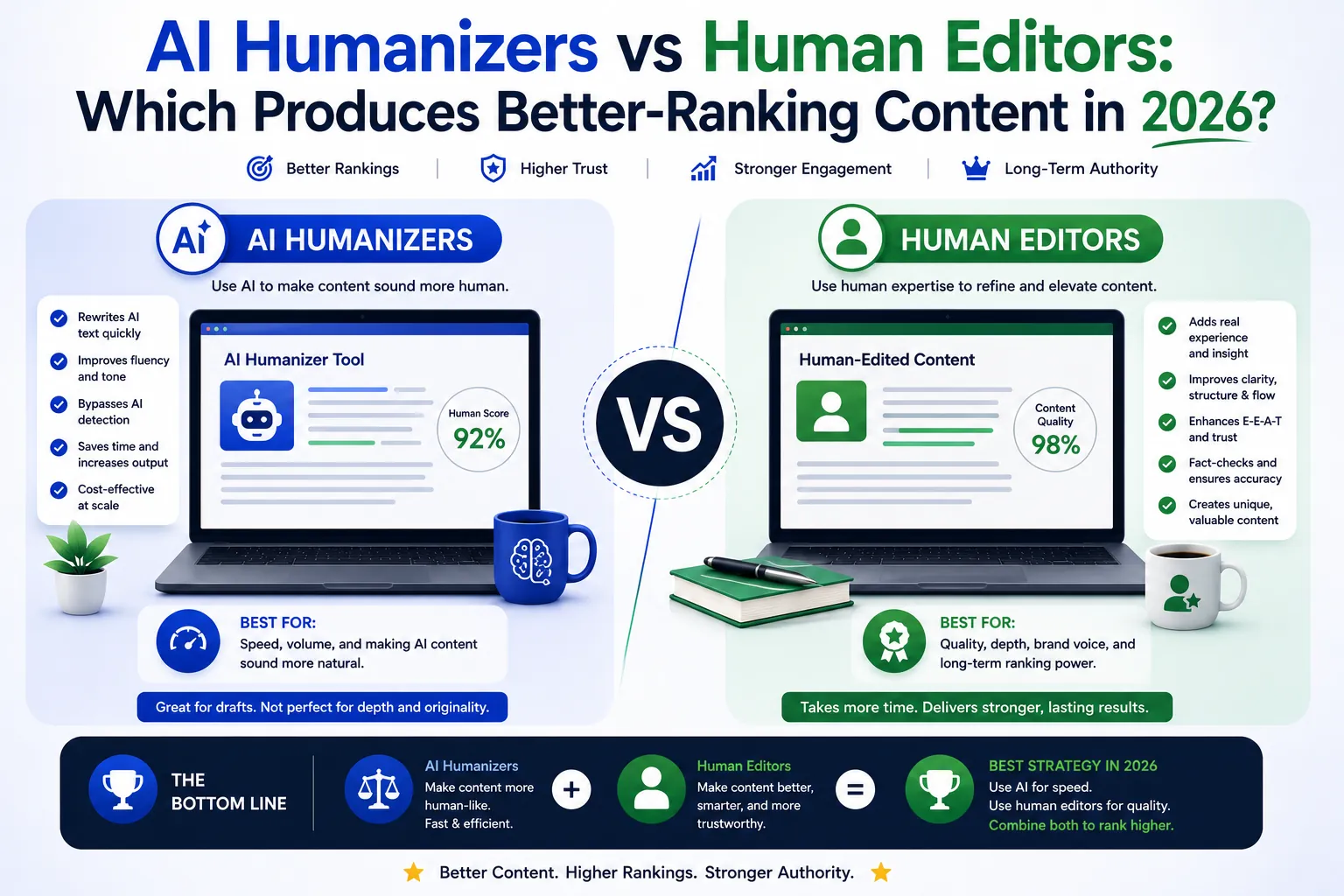
Human-edited AI: AI generates the first draft. A human editor significantly rewrites sections, adds original data, adjusts the voice, and verifies facts. This hybrid approach is increasingly common in 2026.
| Dimension | AI-Generated | Human-Edited AI | Human-Written |
|---|
| Production speed | 1-2 hours per article | 3-5 hours | 6-10 hours |
| Cost per article | $10-$30 | $100-$300 | $300-$1,000+ |
| 6-month rank retention | 5-10% | 25-35% | 30-40% |
| Backlinks per article | 0.2-0.5 | 1-3 | 2-5 |
| Conversion rate | 0.3-0.8% | 1.5-3.5% | 2-5% |
| E-E-A-T signals | Low | Medium | High |
Ranking Test Results (2026)
A study across 300 articles in 10 niches tested three approaches head to head. The methodology was published by Originality.ai in January 2026 and tracked ranking positions, dwell time, and backlink acquisition over a 180-day period.
Key findings:
| Metric | AI-Generated | Human-Edited AI | Human-Written |
|---|
| Top 50 in 30 days | 20-30% | 40-50% | 35-45% |
| Top 50 maintained at 180 days | 5-10% | 25-35% | 30-40% |
| Average dwell time | 45 seconds | 2 minutes | 3.5 minutes |
| Pages with 0 backlinks | 80% | 40% | 25% |
AI-generated content ranks quickly because it follows formatting patterns Google recognizes. It fails long-term because it lacks the depth, originality, and E-E-A-T signals that sustain rankings. Human-written content takes longer to reach top positions. Once there, it stays longer and attracts more supporting signals.
Human-edited AI offers the best balance for most B2B teams: faster production than fully human, with higher quality than fully AI.
E-E-A-T Impact
Google’s Search Quality Rater Guidelines prioritize four signals: Experience, Expertise, Authoritativeness, and Trustworthiness.
| E-E-A-T Signal | AI Can Satisfy | AI Cannot Satisfy |
|---|
| Experience | No | First-hand insights, case studies, real outcomes |
| Expertise | Surface-level facts | Deep domain knowledge, credentials |
| Authoritativeness | Citations (if prompted) | Industry recognition, peer validation |
| Trustworthiness | Factual claims (if correct) | Reputation, track record, accountability |
AI content fails hardest on Experience. Google’s algorithm updates in 2024 and 2025 increasingly prioritized content that demonstrates real-world use. A post about “how to run a content audit” written by someone who has never run one will lose to a post written by a practitioner who can describe specific findings.
A Princeton University and KDD 2024 study by Aggarwal and colleagues tested nine content tactics across 10,000 queries and found that adding expert quotations produced a 30% lift in AI citation rates. Expert quotations require actual experts. AI generated text cannot satisfy the Experience dimension because it has no first-hand experience to share.
| Approach | Monthly Cost (8 articles) | Monthly Traffic (6-month avg) | Cost per Visitor |
|---|
| AI-generated | $80-$240 | 2,000-5,000 | $0.04-$0.05 |
| Human-edited AI | $800-$2,400 | 8,000-15,000 | $0.10-$0.16 |
| Human-written | $2,400-$8,000 | 12,000-25,000 | $0.20-$0.32 |
AI-generated content costs less per visitor but produces fewer total visitors and almost no backlinks. Human-written content costs more upfront but builds an asset that continues compounding.
The ROI calculus flips at scale. A site with 50 AI-generated articles that lose rankings after 6 months must continuously produce new content just to maintain traffic. A site with 50 human-written articles that retain rankings builds a compounding asset.
When to Use Each Approach
Use AI-generated content when:
- You need internal documentation or knowledge base entries
- You are producing glossary pages or basic definitions
- Speed matters more than long-term ranking
- The topic is low-stakes and non-YMYL
Use human-edited AI when:
- You need consistent blog output with quality control
- You have subject matter experts who can review and enhance drafts
- Budget and speed both matter
Use human-written content when:
- You are creating pillar pages and flagship content
- The topic is YMYL (health, finance, legal)
- You need backlinks and authority signals
- The content represents your brand voice
Common Mistakes
Relying on AI for ranking content. AI generates text that looks correct. It does not generate the depth, original insight, or first-hand experience that sustains rankings.
Publishing AI content without human editing. Raw AI output contains factual errors, generic claims, and patterns Google’s classifiers can detect. Every AI-generated piece needs a human review before publishing.
Assuming human-written is always better. For low-stakes, high-volume content (glossary terms, internal documentation), AI is faster and good enough. The key is knowing which content to assign to which approach.
Checklist: Choosing the Right Approach for Each Article
FAQ
Does Google penalize AI-generated content?
Google’s guidance says it penalizes low-quality content regardless of how it is produced. AI content that meets quality standards is not penalized. In practice, most raw AI content fails quality thresholds.
Can AI content rank long-term?
Rarely. Published test data shows only 5-10% of AI-generated articles retain top 50 positions after 180 days. AI content lacks the E-E-A-T signals that sustain rankings.
What is the best AI content workflow in 2026?
Human-edited AI: generate a draft with AI, then have a subject matter expert rewrite key sections, add original data, and verify every claim. This balances speed with quality.
Should I stop using AI for content?
No. Use AI for research, outlining, first drafts, and low-stakes content. Invest human writers in pillar pages, thought leadership, and content that needs to rank long-term.
Need help finding the right balance between AI and human content? Contact Clienvora for a free content quality audit.
This guide was written by Amir Ali, founder of Clienvora. With four years of experience in SEO content writing and conversion copywriting for B2B and e-commerce clients across the USA and UAE, he has built 180K monthly organic visitors for a single brand and published 500+ pieces across six industries. Connect on LinkedIn or view his portfolio.