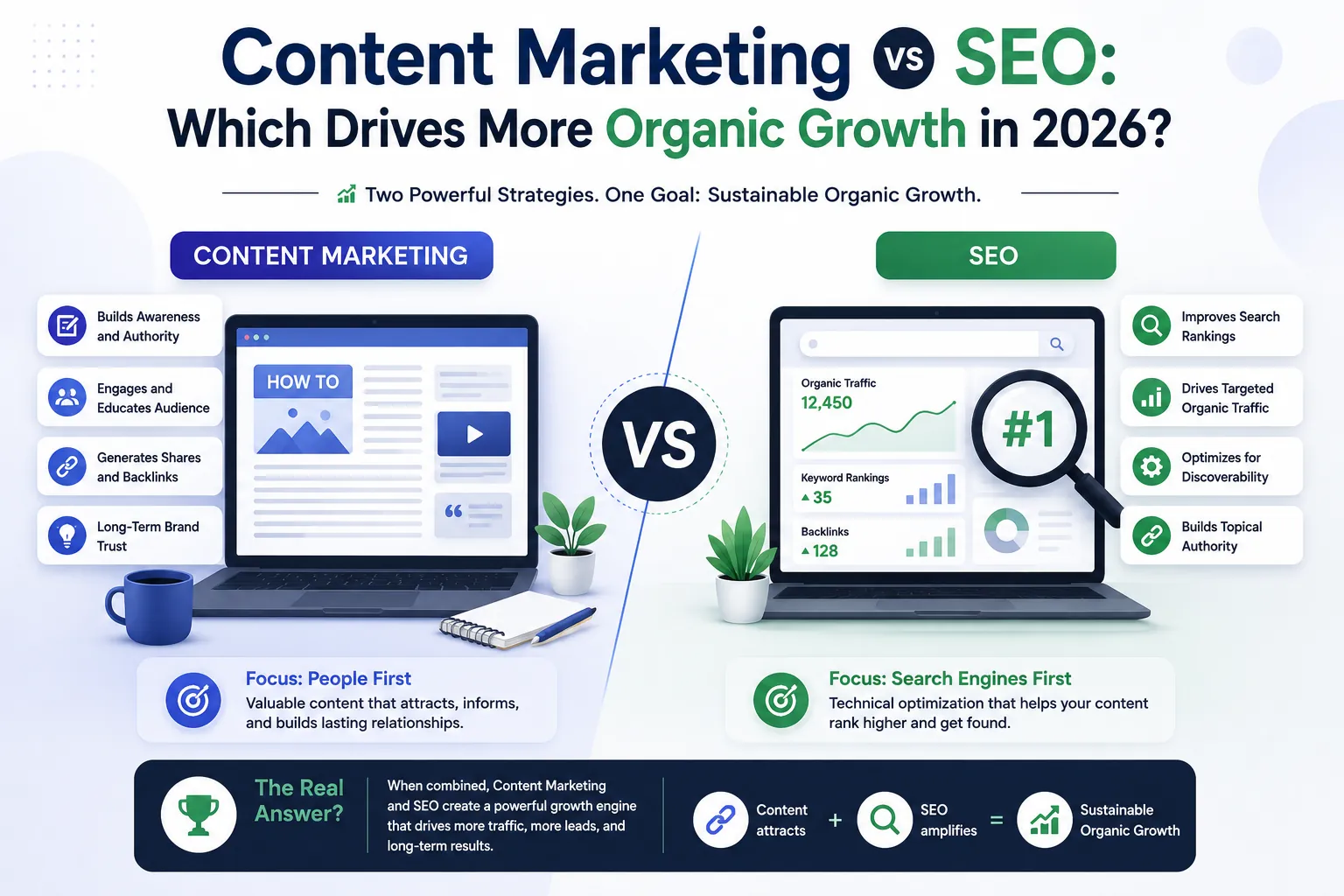
Content marketing vs SEO is not a competition. They are two engines that run on the same fuel. Content marketing produces the material. SEO ensures it gets discovered. Running one without the other is like publishing a book no one can find, or driving traffic to a page that offers nothing worth reading.
The question most B2B teams actually need answered is not which one matters more. It is how to split the budget between them at different stages of growth. A 2025 Gartner CMO Spend Survey found that companies allocating at least 30% of marketing budget to content marketing and 20% to SEO reported 1.8x higher organic revenue growth than those splitting budget evenly across all channels.
This is part of our ultimate guide on content marketing vs SEO vs copywriting vs content writing.
About the author: This guide was written by Amir Ali, an SEO content writer and conversion copywriter with four years of experience serving B2B and e-commerce clients across the USA and UAE markets. He has built 180,000 monthly organic visitors for a single e-commerce brand and published 500+ pieces across six industries. He is HubSpot Content Marketing Certified and founder of Clienvora.
Definitions
Content marketing: The strategic process of creating and distributing valuable content to attract, engage, and retain a defined audience. It owns the relationship building, the editorial calendar, and the distribution channels beyond search.
SEO: The practice of improving a website’s visibility in organic search results through technical optimization, keyword research, link building, and entity signals. It owns the discoverability.
| Dimension | Content Marketing | SEO |
|---|
| Primary goal | Brand authority and audience trust | Organic visibility and rankings |
| Core output | Content assets (guides, videos, emails) | Technical improvements, keyword maps |
| Distribution | Multi-channel (search, social, email) | Search engine algorithms |
| Time to measurable impact | 6-12 months | 3-6 months |
| Primary KPI | Subscribers, share of voice, brand mentions | Organic traffic, keyword rankings, CTR |
| Budget share (typical B2B) | 30-40% of marketing budget | 25-35% of marketing budget |
| Scaling mechanism | More content, more channels, more distribution | More pages, more links, more technical depth |
Where Content Marketing Wins
Content marketing builds assets that compound over time.
A single well-researched pillar guide can drive traffic for years. An email list of 10,000 subscribers lets you reach your audience directly without paying for clicks. A library of case studies and testimonials shortens every future sales cycle.
Content marketing wins on:
- Long-term brand building
- Audience ownership (email, RSS, social followers)
- Multi-channel distribution (search is one of many)
- Customer retention and loyalty
- Pipeline influence across the entire funnel
HubSpot built a $1B+ business primarily on content marketing. Their blog, academy, and free tools generate leads without paid advertising. SEO amplifies their reach, but content marketing is the foundation.
Where SEO Wins
SEO captures demand that already exists. Someone searching “SaaS content strategy” has a problem they want solved right now. SEO puts your page in front of them at the exact moment of need.
SEO wins on:
- Capturing existing demand
- Free, consistent traffic at scale
- Measurable ROI (traffic, rankings, conversions)
- Speed to initial results (3-6 months versus 6-12 for content marketing)
- Competitive moat (content that ranks is hard to displace)
A site ranking number one for a 2,000-search-per-month keyword gets roughly 30% of those clicks without paying for ads. That traffic arrives daily without ongoing content marketing effort.
One data point that reframes the debate: a July 2025 study by SparkToro and Similarweb found that 58% of Google searches now end without a click to any website. For content marketing, this means the audience you build on your own domain (email, RSS) becomes relatively more valuable because organic clicks are shrinking. For SEO, it means the click-through rate you optimize for in 2026 is lower than it was in 2020, making each ranking position less valuable in isolation.
The Budget Allocation Framework
| Company Stage | Content Marketing | SEO | Rationale |
|---|
| Pre-revenue / Pre-PMF | 20% | 80% | Validate demand through search. Low-cost content targeting informational keywords |
| Early traction (0-50 customers) | 40% | 60% | Build brand while capturing existing demand |
| Growth (50-500 customers) | 50% | 50% | Balance brand building with demand capture |
| Scale (500+ customers) | 60% | 40% | Content marketing drives retention, upsells, and brand moat |
The split shifts toward content marketing as the company matures because the volume of existing demand is finite. SEO can only capture what people already search for. Content marketing creates demand by reaching people who are not searching yet.
The Integration Model
The most effective approach combines both disciplines in a structured workflow.
How they connect:
- SEO identifies high-opportunity keywords based on search volume, competition, and intent
- Content marketing builds an editorial calendar around those keywords
- Content writers produce the posts and guides targeting each keyword
- SEO optimizes each piece for on-page signals, internal linking, and schema
- Content marketing distributes the finished piece through email, social, and partnerships
- SEO tracks rankings and traffic. Content marketing tracks subscribers and pipeline influence
Break this loop and either discipline underperforms. SEO without content marketing produces rankings for pages no one wants to read. Content marketing without SEO produces great content no one finds.
ROI Comparison
| Metric | Content Marketing (12-month) | SEO (12-month) |
|---|
| Typical traffic growth | 2-5x from baseline | 3-10x from baseline |
| Cost per lead (mature program) | $50-$200 | $20-$100 |
| Time to positive ROI | 9-18 months | 6-12 months |
| Asset durability | High (content compounds) | Medium (requires maintenance) |
| Scalability ceiling | Audience size | Search volume |
SEO typically shows faster ROI. Content marketing shows higher ROI over longer timeframes. Both are necessary for sustained organic growth.
Common Mistakes
Investing in SEO without content marketing. You rank for keywords, but visitors find thin pages and leave. Traffic without engagement is a vanity metric.
Investing in content marketing without SEO. You produce excellent content that no one discovers. Quality without distribution is a hobby.
Splitting budget arbitrarily. Teams often allocate based on what is easiest to measure rather than what drives growth. SEO gets budget because rankings are trackable. Content marketing gets neglected because brand lift is harder to measure.
Checklist: Where to Invest Next
FAQ
Can you do content marketing without SEO?
Yes, but you need another distribution channel. Email newsletters, social media, and paid ads can distribute content without SEO. You limit your reach to your existing audience and their networks.
Can you do SEO without content marketing?
Yes, for transactional pages. Product pages, pricing pages, and directory pages can rank without a content marketing program. They miss the top-of-funnel traffic that content attracts.
Which should a startup invest in first?
SEO. Content marketing takes longer to show results. Startups need traffic fast. Invest 80% in SEO and 20% in content marketing until you have traffic, then shift toward content marketing.
How has GEO changed the balance?
GEO (Generative Engine Optimization) adds a new layer. Both content marketing and SEO now need to optimize for AI citations, not just traditional rankings. See our GEO vs SEO vs AEO guide for details.
Not sure how to split your marketing budget? Contact Clienvora for a free marketing operations audit.
This guide was written by Amir Ali, founder of Clienvora. With four years of experience in SEO content writing and conversion copywriting for B2B and e-commerce clients across the USA and UAE, he has built 180K monthly organic visitors for a single brand and published 500+ pieces across six industries. Connect on LinkedIn or view his portfolio.