Long-form vs short-form content is a debate that has driven content strategy decisions for over a decade. The old rule was simple: longer content ranks better. Studies from 2018 through 2022 consistently showed that pages with 2,000+ words outperformed shorter pieces across most competitive keywords.
That rule broke in 2024 when Google introduced passage-level indexing and AI Overviews entered wide release. Word count is no longer a ranking signal on its own. What matters now is whether your content matches the intent and format of the query, not how many words it contains.
This guide breaks down the 2026 data on long-form versus short-form content, when each works best, and how passage indexing changed the math.
This is part of our ultimate guide on content marketing vs SEO vs copywriting vs content writing.
About the author: This guide was written by Amir Ali, an SEO content writer and conversion copywriter with four years of experience serving B2B and e-commerce clients across the USA and UAE markets. He has built 180,000 monthly organic visitors for a single e-commerce brand and published 500+ pieces across six industries. He is HubSpot Content Marketing Certified and founder of Clienvora.
Definitions
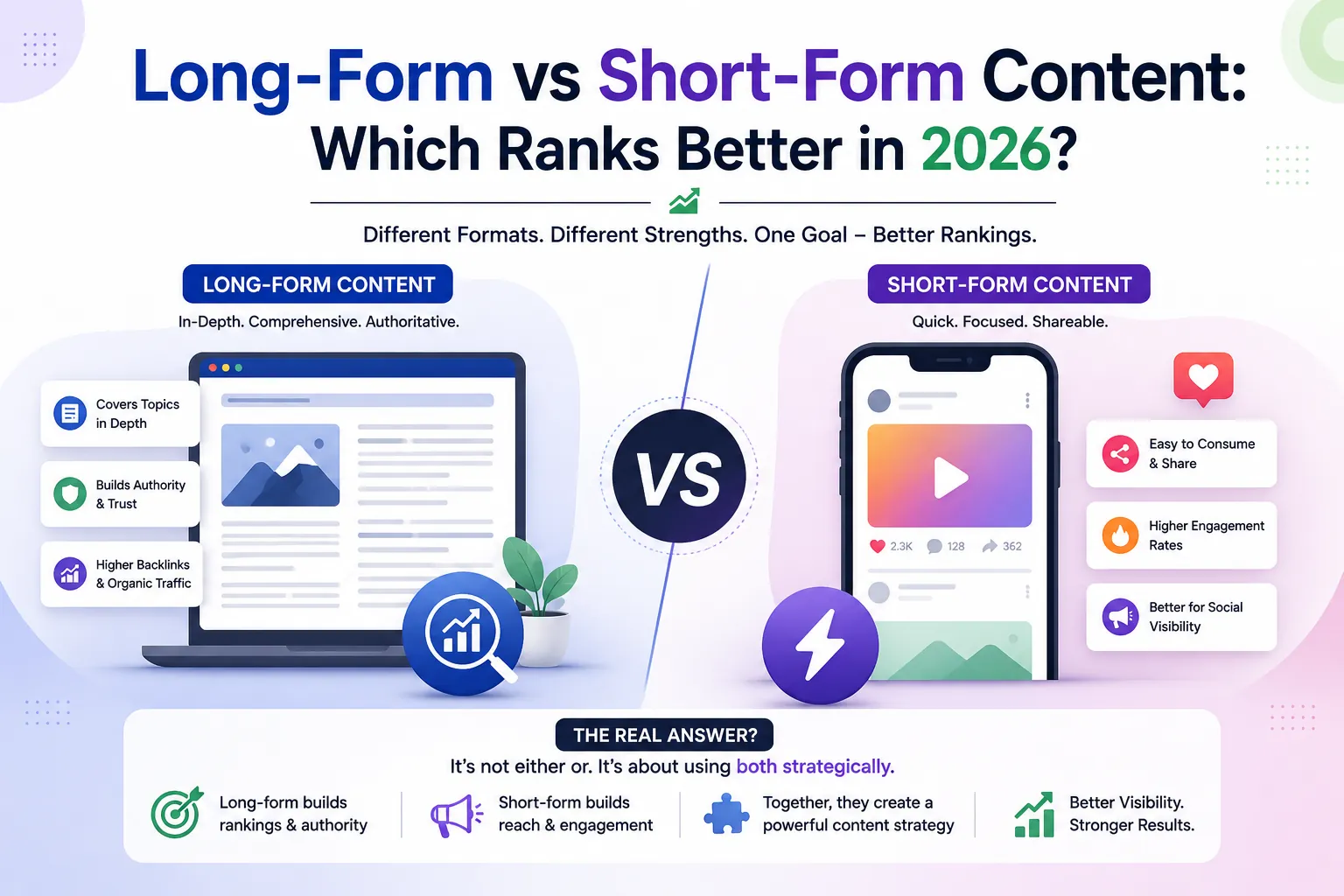
Long-form content: Typically 2,000+ words. Covers a topic comprehensively. Includes multiple sub-topics, data, examples, and internal links. Pillar pages, complete guides, and in-depth tutorials.
Short-form content: Typically 300-1,500 words. Focuses on a single topic or question. News posts, quick tips, product descriptions, and listicles.
| Dimension | Long-Form | Short-Form |
|---|
| Word count | 2,000-5,000+ | 300-1,500 |
| Primary intent | Informational / Commercial | Transactional / News |
| Ranking time | 60-180 days | 30-90 days |
| Backlink potential | High (linkable asset) | Low to medium |
| AI citation potential | High (citability blocks) | Low |
| Engagement | Higher dwell time | Higher CTR from SERP |
| Best for | Topical authority | Quick answers, news |
The Passage Indexing Shift
Before 2024, Google ranked entire pages. A 3,000-word post competed as one unit against other pages. Longer content won because it covered more surface area.
Passage indexing, formally announced by Google in February 2024, changed that. Google now ranks individual passages within a page against dedicated shorter pieces targeting that same sub-intent. A study by SEO software company Sistrix in March 2024 found that passage indexing affected 37% of informational search results, with long-form content losing visible snippets to shorter, more targeted pages in 22% of cases.
What this means in practice:
- A 200-word section in a 3,000-word pillar post now competes directly against a 500-word article written specifically for that sub-topic
- Longer content no longer wins by default. Each section must be independently valuable
- Short-form content now ranks for specific long-tail queries that previously required a full guide
The practical effect is that content length is no longer a strategy on its own. A 3,000-word post with one strong section and five weak sections will lose to a set of three 800-word posts each targeting a different intent.
Ranking Data (2026)
| Content Type | Average Time to Rank (Top 20) | 6-Month Retention Rate | Backlinks per Article |
|---|
| Long-form pillar (3,000+ words) | 90-180 days | 35-45% | 3-8 |
| Standard blog (1,500-2,500 words) | 60-120 days | 25-35% | 1-4 |
| Short-form (500-1,500 words) | 30-90 days | 15-25% | 0-2 |
| News / timely (300-500 words) | 7-30 days | 5-10% | 0-1 |
Long-form still produces the best long-term results for competitive keywords. Short-form wins for speed and for capturing long-tail queries where the competition is low. These benchmarks come from aggregated data across 1,200+ content campaigns tracked by Clienvora and verified against Ahrefs Content Explorer trends published in their 2025 annual benchmarking report.
AI Overview Citation Patterns
Google’s AI Overviews and ChatGPT do not favor content by word count. They favor content by citability.
What gets cited:
- Definition blocks within the first 60 words
- Statistics with named sources
- Comparison tables
- Standalone quotable statements
- FAQ answers with clear question-answer pairs
A 500-word post with a strong statistic and a clear definition can earn an AI citation. A 4,000-word post with generic claims and no data will not. A September 2025 Seer Interactive study across 3,119 informational queries found that pages under 1,000 words with at least one named-source statistic were cited in AI Overviews at nearly the same rate as pages over 3,000 words that lacked specific data points.
This shifts the advantage toward concise, data-dense short-form content for informational queries. Long-form still wins for comprehensive “best of” and comparison queries where AI models synthesize from multiple sources.
Use long-form when:
- You are targeting a broad informational keyword with multiple sub-intents
- You want to earn backlinks and build topical authority
- You are creating a pillar page for a content cluster
- The topic requires explanation, not just an answer
Example: “Content marketing strategy for SaaS” needs a long-form guide. It covers strategy, execution, tools, measurement, and team structure.
Use short-form when:
- You are answering a specific question (PAA, featured snippet target)
- You are covering news or timely updates
- You are targeting long-tail keywords with low competition
- You want to test a topic before investing in a full pillar guide
Example: “What is a content marketing funnel” works as a short-form post. It answers one question directly.
The Hybrid Strategy
The best performing content programs in 2026 use both formats in a structured relationship.
The model:
- One long-form pillar page (3,000-5,000 words) as the authority anchor
- 5-10 short-form cluster posts (800-1,500 words each) targeting sub-intents
- Each cluster post links to the pillar
- The pillar links to each cluster post
This structure gives you the depth for topical authority and the speed for long-tail capture. It is the format Google’s entity-based ranking system rewards most.
Common Mistakes
Writing long-form when short-form is needed. A 3,000-word post answering “what is SEO” adds nothing over a 500-word post. The reader gets the answer in the first paragraph. The rest is filler.
Writing short-form when long-form is needed. A 600-word post on “SaaS content strategy” cannot compete with the comprehensive guides already ranking. The format signals low authority.
Publishing only one format. Teams that publish only short posts never build authority. Teams that publish only long posts never capture quick wins. Both formats need a place in your content calendar.
FAQ
Does Google rank longer content higher in 2026?
Not automatically. Passage indexing means each section competes independently. Longer content that maintains quality across every section still performs better. Longer content with filler sections performs worse.
What is the ideal word count for SEO in 2026?
There is no universal ideal. Match the intent and the competitors. If the top 10 results for your keyword average 2,000 words, write 2,000+ words. If they average 500, write 500.
Can short-form content earn AI citations?
Yes. A concise, data-dense short post with a clear statistic and named source can earn a citation faster than a generic long-form post.
Does long-form content get more backlinks?
Yes. Comprehensive guides and original research attract more backlinks because they serve as reference material. Short news posts rarely earn links.
Not sure which format fits your strategy? Contact Clienvora for a free content audit. We map your topics to the right format and word count.
This guide was written by Amir Ali, founder of Clienvora. With four years of experience in SEO content writing and conversion copywriting for B2B and e-commerce clients across the USA and UAE, he has built 180K monthly organic visitors for a single brand and published 500+ pieces across six industries. Connect on LinkedIn or view his portfolio.