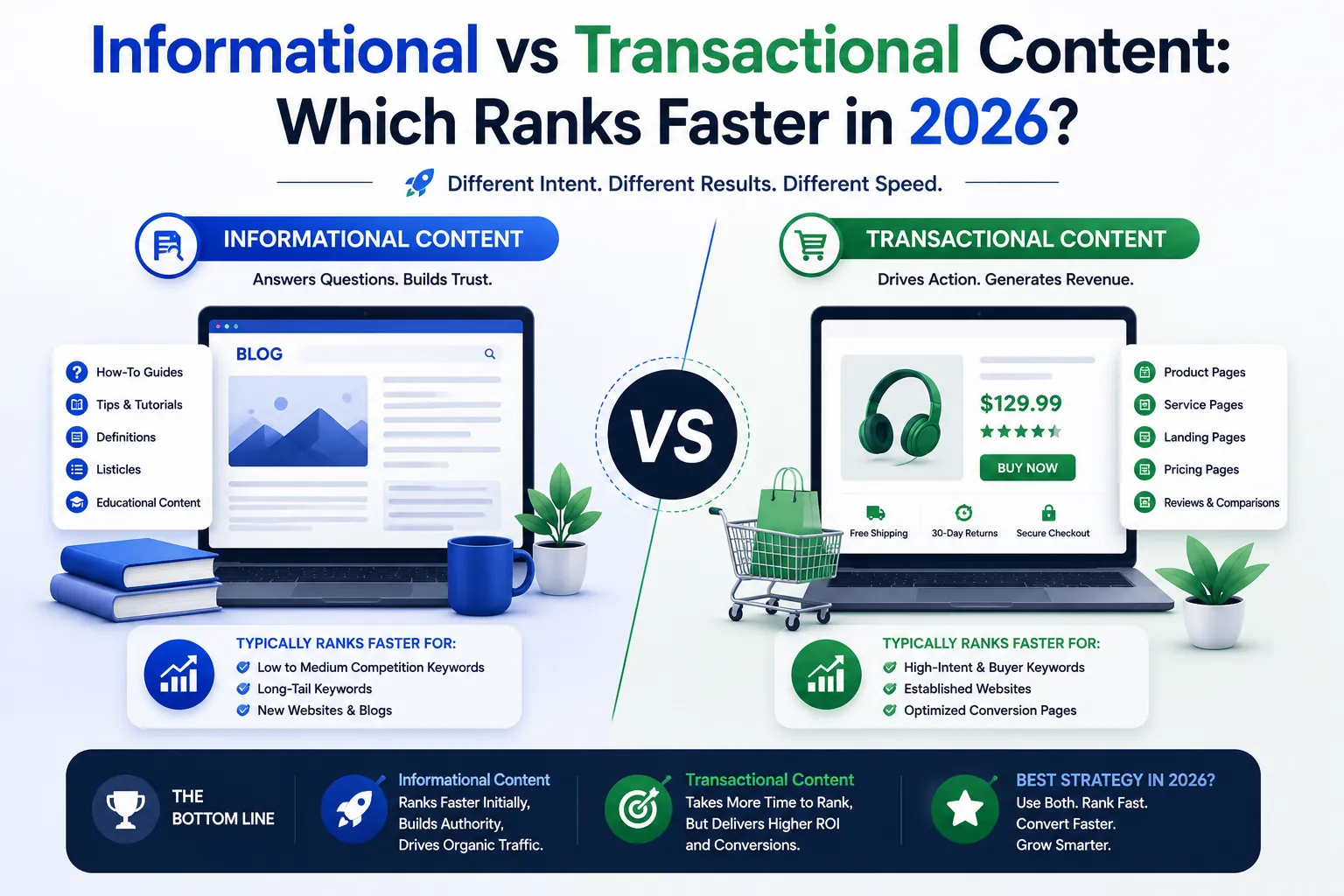
Informational vs transactional content is a distinction that determines how fast your content ranks and how much revenue it generates per visitor. Informational content ranks faster. Transactional content generates more revenue per visitor.
That is the trade-off every content team faces. Informational posts target queries with lower competition and broader intent, reaching top positions in 30 to 90 days. Transactional pages target high-intent queries with established competitors, often taking 90 to 180 days to rank.
This guide breaks down the time-to-rank data, AI Overview patterns, and a practical strategy for balancing both types.
This is part of our ultimate guide on content marketing vs SEO vs copywriting vs content writing.
About the author: This guide was written by Amir Ali, an SEO content writer and conversion copywriter with four years of experience serving B2B and e-commerce clients across the USA and UAE markets. He has built 180,000 monthly organic visitors for a single e-commerce brand and published 500+ pieces across six industries. He is HubSpot Content Marketing Certified and founder of Clienvora.
Definitions
Informational content: Content created for users seeking answers, research, or education. The searcher wants to learn, not to buy. Examples: how-to guides, tutorials, definitions, research reports.
Transactional content: Content created for users ready to take a specific action. The searcher wants to buy, sign up, or request a demo. Examples: product pages, pricing pages, demo request forms, landing pages.
Commercial content: A hybrid category. Users comparing options before a purchase. Examples: best-of lists, comparison posts, review pages.
| Dimension | Informational | Commercial | Transactional |
|---|
| Search intent | Learning | Comparing | Buying |
| Typical format | Guide, tutorial | Comparison, review | Landing, pricing |
| Time to rank | 30-90 days | 60-120 days | 90-180+ days |
| Traffic volume | High | Medium | Low |
| Conversion rate | 0.5-2% | 2-5% | 5-10%+ |
| AI Overview likelihood | High | Medium | Low |
Search Intent Deep Dive
Google’s SERP features now vary significantly by intent type.
Informational SERPs:
- AI Overviews dominate simple informational queries
- Featured snippets and People Also Ask boxes are common
- Video carousels appear for how-to queries
- Top 10 results are typically guides and tutorials
Transactional SERPs:
- Product carousels and shopping ads
- Local packs for service-based queries
- Review sites for software purchases
- Top 10 results are typically product pages and comparison sites
Commercial SERPs:
- Mixed format: guides + product pages + comparison sites
- AI Overviews appear for comparison queries
- Featured snippets for “best of” queries
Understanding the SERP features for your target keyword tells you which format to use. If Google shows AI Overviews and guides, write informational content. If Google shows product pages and ads, write transactional content.
Time-to-Rank Data (2026)
| Content Type | Time to Page 1 | Time to Top 3 | 6-Month Retention |
|---|
| Informational guide (low competition) | 30-60 days | 60-120 days | 30-40% |
| Informational guide (high competition) | 60-120 days | 120-180 days | 20-30% |
| Comparison / Commercial | 60-120 days | 90-180 days | 25-35% |
| Transactional (low competition) | 60-90 days | 90-150 days | 20-30% |
| Transactional (high competition) | 90-180+ days | 180-365+ days | 10-20% |
Informational content ranks faster because it targets queries with lower competition. Transactional content targets queries where established brands with strong domain authority dominate.
AI Overview Citation Patterns
AI Overviews and ChatGPT favor different content types depending on the query.
Informational queries:
- High citation rate for definitional content (first 60 words)
- Statistics with named sources get cited frequently
- Step-by-step guides with clear structure
- Simple informational queries are often zero-click (AI answers directly)
Transactional queries:
- Low citation rate for direct transactional pages
- AI may summarize features from multiple product pages
- Comparison tables and pricing data get cited
- Local queries trigger map and listing results
How to optimize for each:
- For informational: add clear definitions, statistics, and quotable statements in the first 60 words
- For transactional: add structured data (Product schema, Offer schema), comparison tables, and clear pricing information
ROI Comparison
| Metric | Informational | Commercial | Transactional |
|---|
| Monthly traffic potential | 1,000-5,000+ sessions | 500-2,000 sessions | 100-500 sessions |
| Conversion rate | 0.5-2% | 2-5% | 5-10%+ |
| Revenue per 1,000 visitors | $50-$200 | $200-$500 | $500-$2,000+ |
| Content production cost | $300-$1,000 | $400-$1,200 | $500-$1,500 |
| Asset half-life | 12-24 months | 6-12 months | 3-6 months |
Transactional content generates more revenue per visitor. Informational content generates more total visitors. Most B2B sites need both, with the ratio determined by their traffic and revenue goals.
The Hybrid Strategy
The most efficient approach combines both content types in a structured funnel.
The model:
- Informational pillar (ranks fast, drives traffic, builds authority)
- Commercial comparison posts (capture mid-funnel intent)
- Transactional landing pages (convert bottom-funnel traffic)
- Internal links from informational to commercial to transactional
Example for a project management SaaS:
| Content Type | Target Keyword | Links To |
|---|
| Informational guide | ”How to manage remote teams” | Comparison post |
| Comparison post | ”Best project management tools for remote teams” | Landing page |
| Landing page | ”[Product] for remote teams” | Signup / demo |
The informational guide does the ranking work. The comparison post captures mid-funnel intent. The landing page converts. Internal links pass authority from the guide through the comparison to the landing page.
Common Mistakes
Targeting transactional keywords with informational content. Writing a guide for a keyword where searchers want to buy. The format mismatches intent and the page will not convert.
Targeting informational keywords with transactional content. Building a landing page for a keyword where searchers want to learn. The page will not rank because Google rewards educational content for that query.
Ignoring commercial intent. Most content strategies include only informational and transactional. Commercial intent (comparisons, best-of) captures the critical middle of the funnel.
Checklist: Choosing the Right Content Type
FAQ
Does informational content always rank faster?
Generally yes, because competition is lower. A well-written informational guide targeting a low-competition keyword can reach page one in 30 days. Transactional pages in the same niche may take 6-12 months.
Does transactional content ever rank fast?
Only for low-competition keywords or when the site has strong domain authority. New sites should target informational keywords first and build transactional pages after establishing authority.
How has AI Overviews changed the balance?
AI Overviews reduced click-through rates for informational queries. Seer Interactive found organic CTR dropped 61% for queries with AI Overviews. This makes transactional content relatively more valuable because it is less affected by AI Overviews.
Not sure which content type fits your keywords? Contact Clienvora for a free content audit. We map your keywords to the right format and intent.
This guide was written by Amir Ali, founder of Clienvora. With four years of experience in SEO content writing and conversion copywriting for B2B and e-commerce clients across the USA and UAE, he has built 180K monthly organic visitors for a single brand and published 500+ pieces across six industries. Connect on LinkedIn or view his portfolio.
The B2B Organic Growth Dispatch
One short, useful email each month on SEO, copywriting, and GEO for B2B. No fluff, no spam.