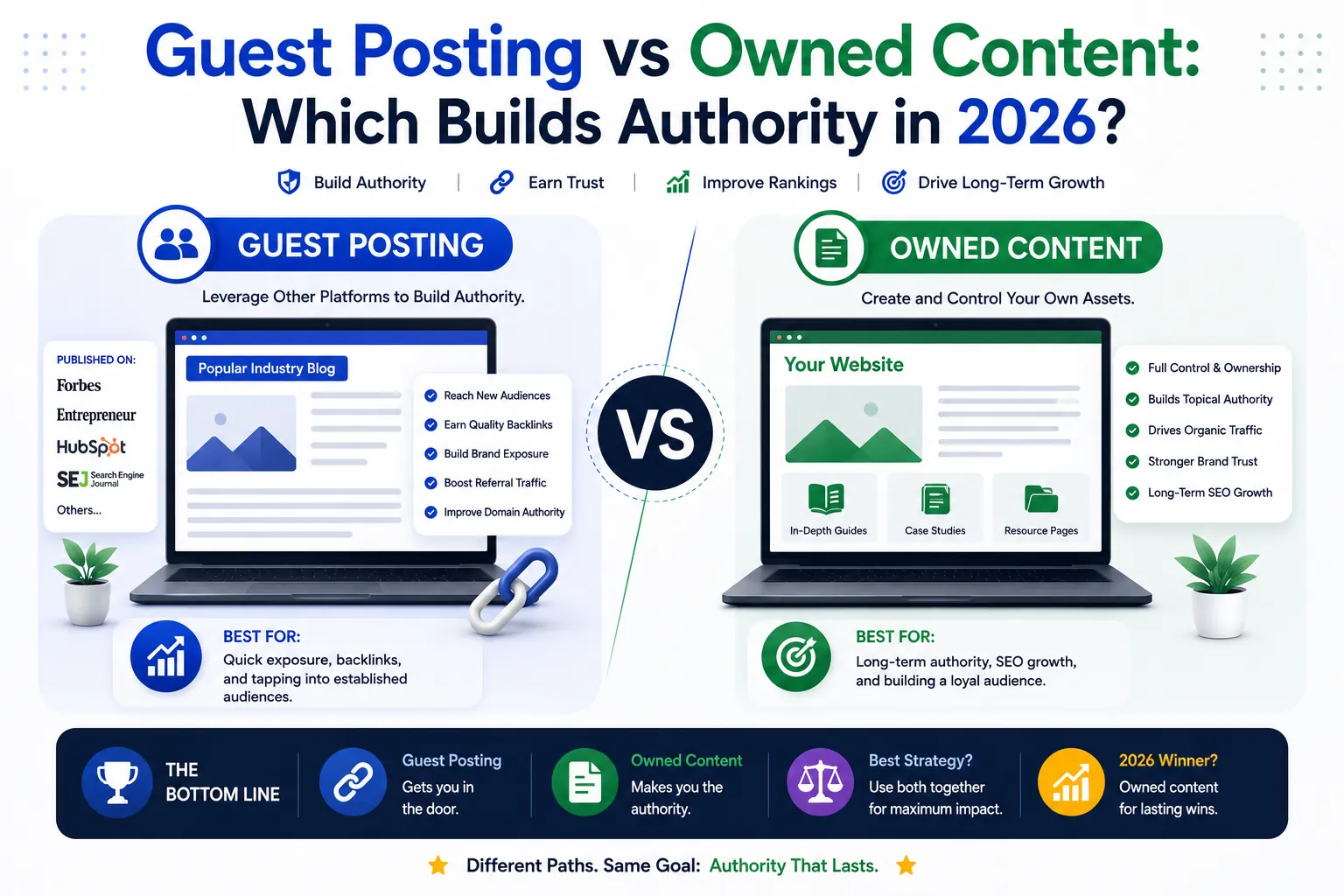
Guest posting vs owned content is a distribution decision that determines how you build authority and where that authority lives. They build authority through different mechanisms.
Guest posting earns external signals: backlinks from authoritative domains, referral traffic, and brand exposure on third-party platforms. Owned content builds internal signals: a direct audience, email subscribers, and search rankings on your own domain.
One builds external proof. One builds internal assets. The best strategy uses both, but the ratio depends on your stage and goals.
This is part of our ultimate guide on content marketing vs SEO vs copywriting vs content writing.
About the author: This guide was written by Amir Ali, an SEO content writer and conversion copywriter with four years of experience serving B2B and e-commerce clients across the USA and UAE markets. He has built 180,000 monthly organic visitors for a single e-commerce brand and published 500+ pieces across six industries. He is HubSpot Content Marketing Certified and founder of Clienvora.
Definitions
Guest posting: Publishing content on third-party websites to earn backlinks, brand exposure, and referral traffic. The content lives on someone else’s domain. You control the message but not the platform.
Owned content: Publishing on your own blog, newsletter, or website to build a direct audience, email list, and search authority. The content lives on your domain. You control everything.
| Dimension | Guest Posting | Owned Content |
|---|
| Primary benefit | External backlinks and exposure | Owned audience and search authority |
| Asset ownership | None (content on third-party site) | Full (content on your domain) |
| Time to impact | Immediate (backlink) to 3 months | 3-12 months (SEO compounding) |
| Cost per piece | $200-$1,000 (content + outreach) | $100-$500 (content only) |
| Scalability | Limited by outreach capacity | Limited by content production |
| Risk | Low-quality sites can hurt your site | None (full control) |
Backlink Value vs Owned Audience ROI (2026 Data)
| Channel | Metric | Benchmark |
|---|
| Guest post on DR 70+ site | Referral visits per month | 150-400 |
| Guest post on DR 70+ site | New email subscribers per post | 10-30 |
| Guest post on DR 70+ site | Backlink DR lift | 2-5 points (cumulative) |
| Owned blog post (1,500 words) | Organic visits per month (6-month) | 200-800 |
| Owned blog post (1,500 words) | New email subscribers per post | 5-20 |
| Owned blog post (1,500 words) | Backlinks earned | 0.5-2 (if linkable) |
Guest posting produces faster backlink results. Owned content produces compounding traffic and audience growth.
Google HCU Impact on Guest Posting
Google’s Helpful Content Update, folded into the core algorithm in March 2024, changed the value calculation for guest posting.
What changed:
- Google now evaluates content quality at the site level for guest posts
- Low-quality guest posts on low-DR sites provide minimal ranking benefit
- Mass guest posting on irrelevant sites can trigger site-wide quality signals
- Google can distinguish between genuine contributor content and manufactured link building
What still works:
- Guest posting on niche-relevant, high-DR sites (DR 50+)
- Content that provides genuine value to the host site’s audience
- Original insights, case studies, and data that cannot be found elsewhere
- Building relationships with specific editors rather than mass pitching
What no longer works:
- Guest posting on sites where your content has no relevance to the audience
- Publishing the same article on multiple sites
- Low-effort AI-generated guest posts
- Paying for guest posts on sites that exist only for link selling
When to Prioritize Each
| Stage | Owned Content | Guest Posting | Rationale |
|---|
| Startup (pre-PMF) | 70% | 30% | Build audience and retention first. Use guest posting for initial backlinks |
| Growth (post-PMF) | 50% | 50% | Scale both for traffic and authority |
| Established | 40% | 60% | Guest posting on high-DR sites accelerates authority |
The Hybrid Strategy
The most efficient approach treats guest posting and owned content as complementary channels, not alternatives.
The workflow:
- Publish core content on your owned platform (blog, Substack, LinkedIn)
- Identify high-DR sites in your niche where your audience already reads
- Pitch guest posts that expand on topics from your owned content
- Include contextual links back to relevant owned content
- Repurpose guest post insights into new owned content
- Track backlinks and referral traffic from each guest post
Example monthly cadence:
| Week | Owned Content | Guest Posting |
|---|
| 1 | Publish pillar post on blog | Pitch 3 guest posts |
| 2 | Publish cluster post | Write 1 guest post |
| 3 | Publish newsletter | Follow up on guest post pitches |
| 4 | Publish case study | Publish 1 guest post |
Common Mistakes
Guest posting on low-DR sites. A backlink from a DR 20 site provides minimal ranking value and carries HCU risk. Focus on DR 50+ sites in your niche.
Ignoring owned content completely. Some teams spend all their effort on guest posting and never build an owned audience. The guest posts drive temporary traffic, but nothing compounds on their own domain.
No cross-promotion between channels. A guest post that is never shared with your email list or promoted on your social channels misses the amplification opportunity.
Tracking only backlinks. Referral traffic, email subscribers, and brand mentions from guest posts are equally valuable. Track all four metrics.
Checklist: Building a Guest Posting Program
FAQ
Is guest posting still effective for SEO in 2026?
Yes, but only on high-quality, relevant sites. Low-quality guest posting no longer provides ranking value and can trigger HCU penalties.
Can owned content build authority without guest posting?
Yes, but it takes longer. Owned content relies on search rankings, which take 3-12 months for competitive keywords. Guest posting accelerates authority by earning backlinks from established domains.
How many guest posts should I publish per month?
Two to four per month is sustainable. More than that risks quality degradation and outreach fatigue.
Does Substack count as owned content?
Partially. Substack owns the platform, but you own the subscriber list and content. It is a strong middle ground between guest posting and fully owned content.
Need help building an authority strategy that combines guest posting and owned content? Contact Clienvora for a free content audit.
This guide was written by Amir Ali, founder of Clienvora. With four years of experience in SEO content writing and conversion copywriting for B2B and e-commerce clients across the USA and UAE, he has built 180K monthly organic visitors for a single brand and published 500+ pieces across six industries. Connect on LinkedIn or view his portfolio.
The B2B Organic Growth Dispatch
One short, useful email each month on SEO, copywriting, and GEO for B2B. No fluff, no spam.