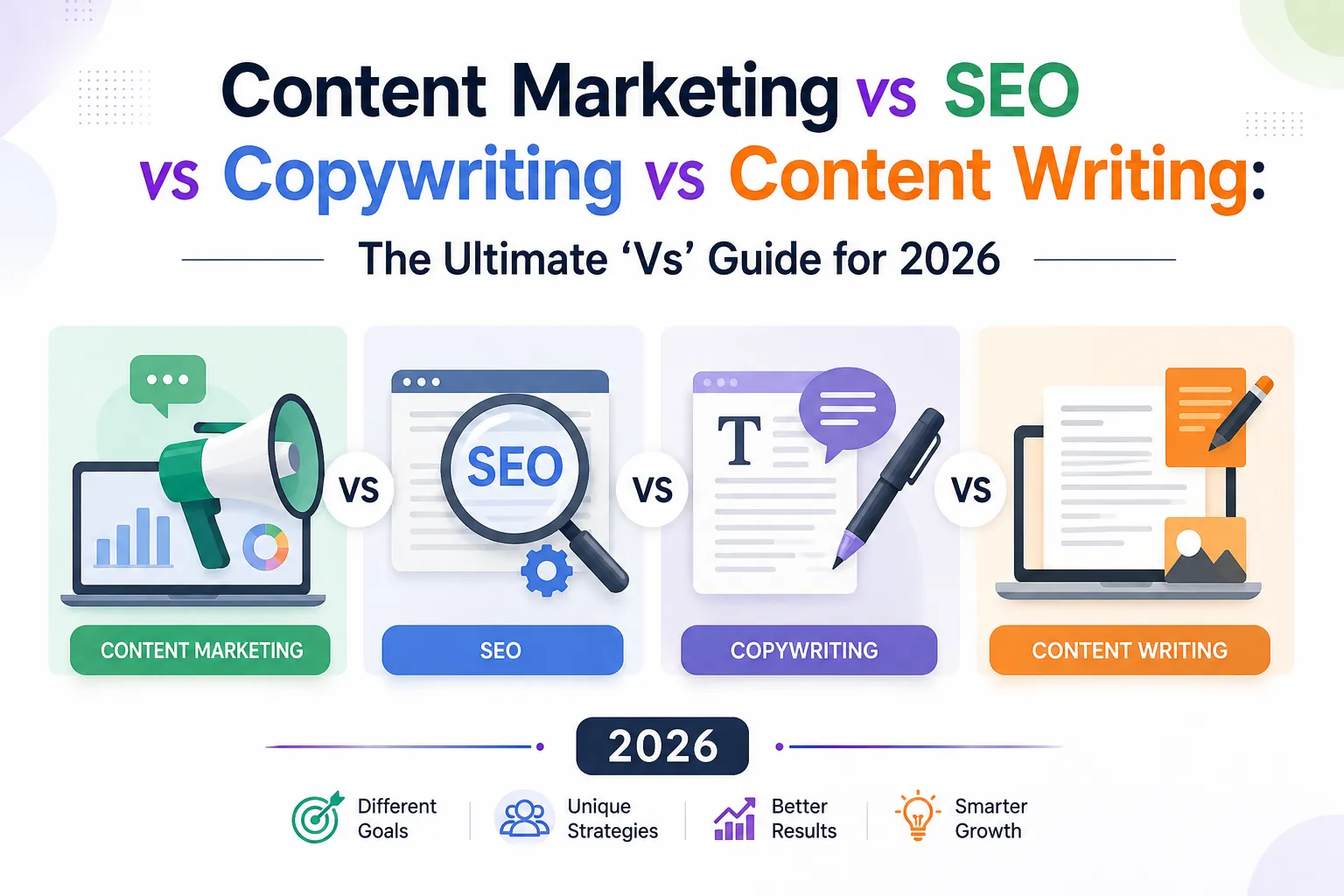
Content marketing vs SEO vs copywriting vs content writing is a comparison that confuses most B2B teams when allocating their marketing budget. Each discipline serves a different purpose, targets a different stage of the buyer journey, and requires a different skill set to execute well.
Most marketers use these four terms interchangeably. They are not the same thing. Content marketing, SEO, copywriting, and content writing serve different goals, measure different KPIs, and require different skills. Using the wrong one for the wrong job is how marketing budgets evaporate without producing measurable outcomes.
This guide breaks down each discipline, shows how they compare across seven dimensions, and gives you a decision framework for 2026. If you want the short version upfront: content marketing owns the strategy, SEO owns the distribution, copywriting owns the conversion, and content writing owns the execution. All four work together. But you need to know which one you need right now.
About the author: This guide was written by Amir Ali, an SEO content writer and conversion copywriter with four years of experience serving B2B and e-commerce clients across the USA and UAE markets. He has built 180,000 monthly organic visitors for a single e-commerce brand and published 500+ pieces across six industries. He is HubSpot Content Marketing Certified and founder of Clienvora.
What Is Content Marketing?
Content marketing is the strategic process of creating and distributing valuable content to attract, engage, and retain a defined audience. Its goal is not immediate conversion. Its goal is long-term brand authority and customer loyalty.
Typical outputs:
- Blog posts and pillar guides
- Email newsletters
- Case studies and white papers
- Videos and podcasts
- Social media content
KPIs: Email subscribers, brand mentions, time on site, share of voice, pipeline influence.
Content marketing answers the question “why should I trust you?” It builds the relationship before the sale. A 2024 HubSpot study found that companies publishing 16 or more blog posts per month get 3.5x more traffic than those publishing four or fewer. The same research showed that B2B companies with active content marketing programs generate 67% more leads per month than those without a defined content strategy.
But content marketing without distribution is just publishing. That is where the other three disciplines come in.
Relevant reading: Our guide on topical authority clusters explains how to structure content marketing around entity-based search rather than keyword density.
What Is SEO?
SEO (Search Engine Optimization) is the practice of improving a website’s visibility in organic search results. It is the distribution engine that makes content findable.
Typical outputs:
- Technical audits and fixes
- Keyword research and intent mapping
- On-page optimization (titles, meta descriptions, headers)
- Link building and entity signals
- Schema markup and structured data
KPIs: Organic sessions, keyword rankings, indexed pages, click-through rate, Core Web Vitals scores.
SEO answers the question “will anyone find this?” A well-written piece of content that no one discovers has the same practical value as a piece of content that was never written.
The discipline shifted significantly between 2023 and 2026. Google’s passage indexing, introduced in February 2024, now allows individual sections of long-form content to rank independently for specific queries. AI Overviews, rolled out widely in May 2025, changed the SERP landscape by providing direct answers for 58% of informational queries, according to SparkToro and Similarweb data. And entity-based search replaced the old keyword-density model as Google’s primary relevance signal.
Another shift worth noting: SEOcrawl research from March 2026 found that 71% of pages cited by ChatGPT include structured data markup. Sites without schema are systematically excluded from AI-generated answers. We covered the full implications in Free SEO Is Not Dead.
What Is Copywriting?
Copywriting is writing that drives a specific action. Where content marketing educates and SEO enables discovery, copywriting converts.
Typical outputs:
- Landing pages
- Email sequences
- Sales pages
- Ad copy
- CTA buttons and product descriptions
KPIs: Conversion rate, click-through rate, revenue attribution, cost per acquisition.
Copywriting answers the question “why should I act now?” It uses frameworks like AIDA (Attention, Interest, Desire, Action) and PAS (Problem, Agitate, Solution) to move readers from interest to commitment.
The difference between content writing and copywriting is not length. It is intent. A 2,000-word landing page is still copywriting if every paragraph exists to push the reader toward a transaction. A 200-word product description is still content writing if its purpose is to inform rather than persuade.
For SaaS teams, the distinction matters most at the bottom of the funnel. A July 2025 study by WordStream found that landing pages with a single clear CTA above the fold convert at 4.2% on average, compared to 1.7% for pages with multiple competing CTAs. That 2.5 percentage point gap often determines whether a paid campaign breaks even.
What Is Content Writing?
Content writing is the craft of producing readable, useful written material for a specific audience. It is the execution layer beneath content marketing strategy and SEO intent mapping.
Typical outputs:
- Blog posts and articles
- Pillar pages and guides
- Knowledge base entries
- Whitepapers and ebooks
- Social media captions
KPIs: Readability score, word count delivered, editorial quality, factual accuracy.
Content writing answers the question “is this actually useful?” A content strategist decides what to write. An SEO specialist decides how to optimize it. But the content writer sits down and produces sentences worth reading.
In 2026, the best content writers do not just string words together. They incorporate original data, client insights, and subject matter expertise. Generic content produced at scale no longer ranks. Google’s Helpful Content System, folded into the core algorithm since the March 2024 Core Update, actively demotes content that lacks demonstrated first-hand experience. Google’s own announcement at the time stated the combined modifications were projected to reduce low-quality and unoriginal content in search results by 40%.
Key Comparisons at a Glance
| Dimension | Content Marketing | SEO | Copywriting | Content Writing |
|---|
| Primary goal | Brand authority and trust | Organic discoverability | Conversion and action | Readable, useful material |
| Core question | ”Why trust you?" | "Will anyone find this?" | "Why act now?" | "Is this useful?” |
| Typical outputs | Campaigns, editorial calendars | Technical audits, keyword maps | Landing pages, email sequences | Blog posts, guides, articles |
| Primary KPI | Subscribers, share of voice | Rankings, organic traffic | Conversion rate, revenue | Quality score, accuracy |
| Time to impact | 6-12 months | 3-6 months | Immediate to 3 months | Varies by distribution |
| Best for | Building long-term authority | Driving free traffic | Capturing demand | Executing the strategy |
| Budget share (typical) | 30-40% | 25-35% | 20-30% | Part of content marketing |
One data point worth calling out separately. A 2025 Gartner CMO Spend Survey found that content marketing accounts for 26% of total marketing budgets on average, while SEO technical work accounts for 11%. Yet companies that allocate at least 30% to content marketing and 20% to SEO report 1.8x higher organic revenue growth than those splitting budget evenly across all four disciplines. The imbalance in budget allocation often misaligns with actual ROI potential.
How They Connect: The Funnel View
Each discipline owns a different stage of the buyer journey.
| Funnel Stage | Lead Discipline | Example |
|---|
| Awareness | Content Marketing + SEO | A pillar guide on “SaaS content strategy” ranks for informational queries |
| Consideration | Content Writing + SEO | Comparison posts and case studies help prospects evaluate options |
| Decision | Copywriting | A landing page with demo CTA converts the prospect |
| Retention | Content Marketing | Email newsletters and exclusive content keep customers engaged |
The most effective marketing teams run all four disciplines in parallel. They do not choose one and abandon the rest. They allocate resources by stage and measure each discipline against its own KPIs.
The mistake most teams make is measuring all four disciplines against the same metric. SEO is slow and steady. Copywriting is fast and direct. Content marketing compounds over years. Using 30-day conversion data to judge a content marketing program is like judging a tree by what it grows in its first week.
The 10 Most Searched “Vs” Questions in 2026
These are the comparisons marketers are searching for right now. Each links to a dedicated deep dive.
- SEO Copywriting vs Content Writing: What is the Real Difference in 2026? - When to write for conversions versus when to write for discoverability.
- Long-Form vs Short-Form Content: Which Ranks Better in 2026? - The data on word count, rankings, and engagement.
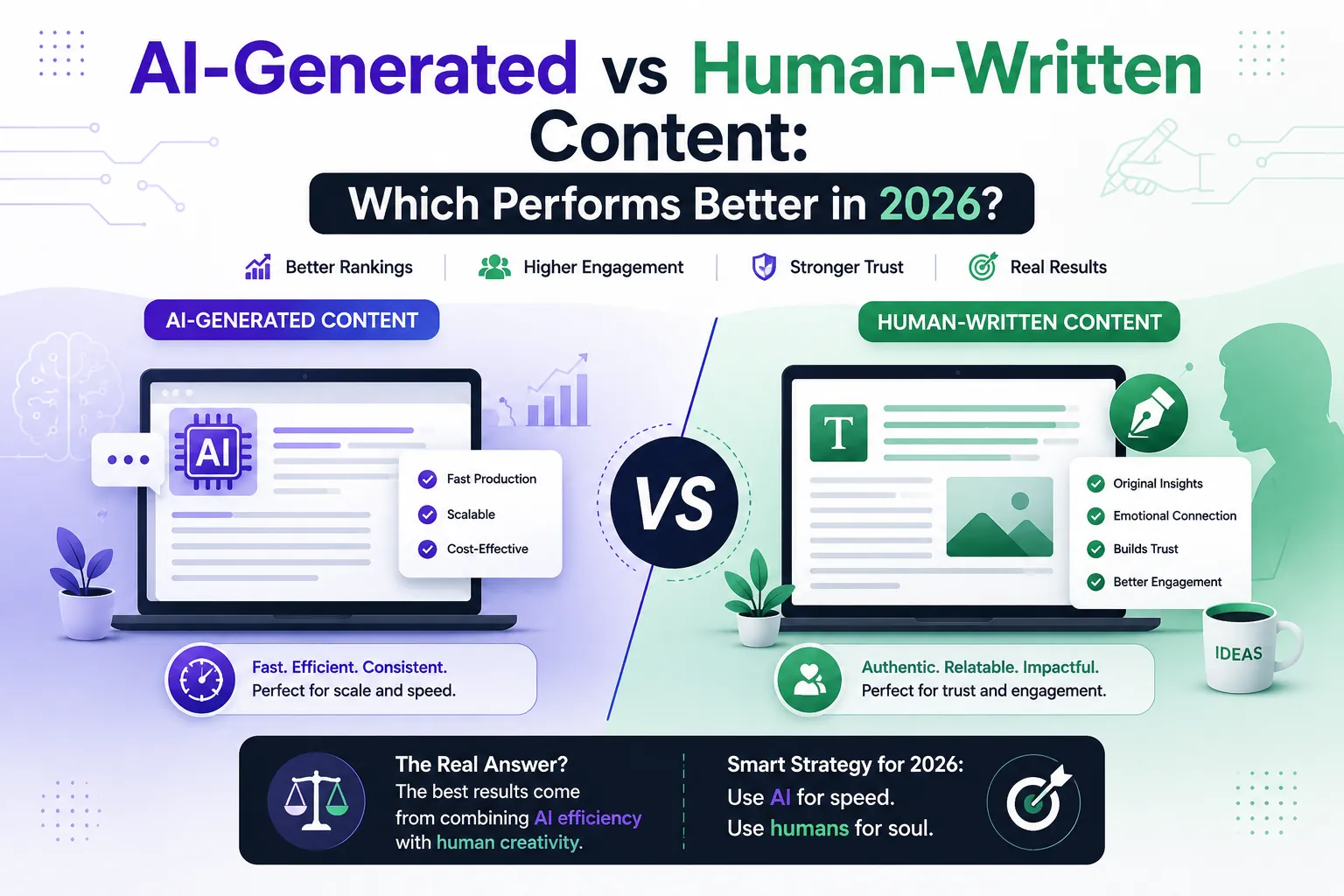
- AI-Generated vs Human-Written Content: Which Performs Better in 2026? - Ranking tests, E-E-A-T impact, and cost comparisons.
- Content Marketing vs SEO: Which Drives More Organic Growth in 2026? - Budget allocation and ROI for B2B teams.
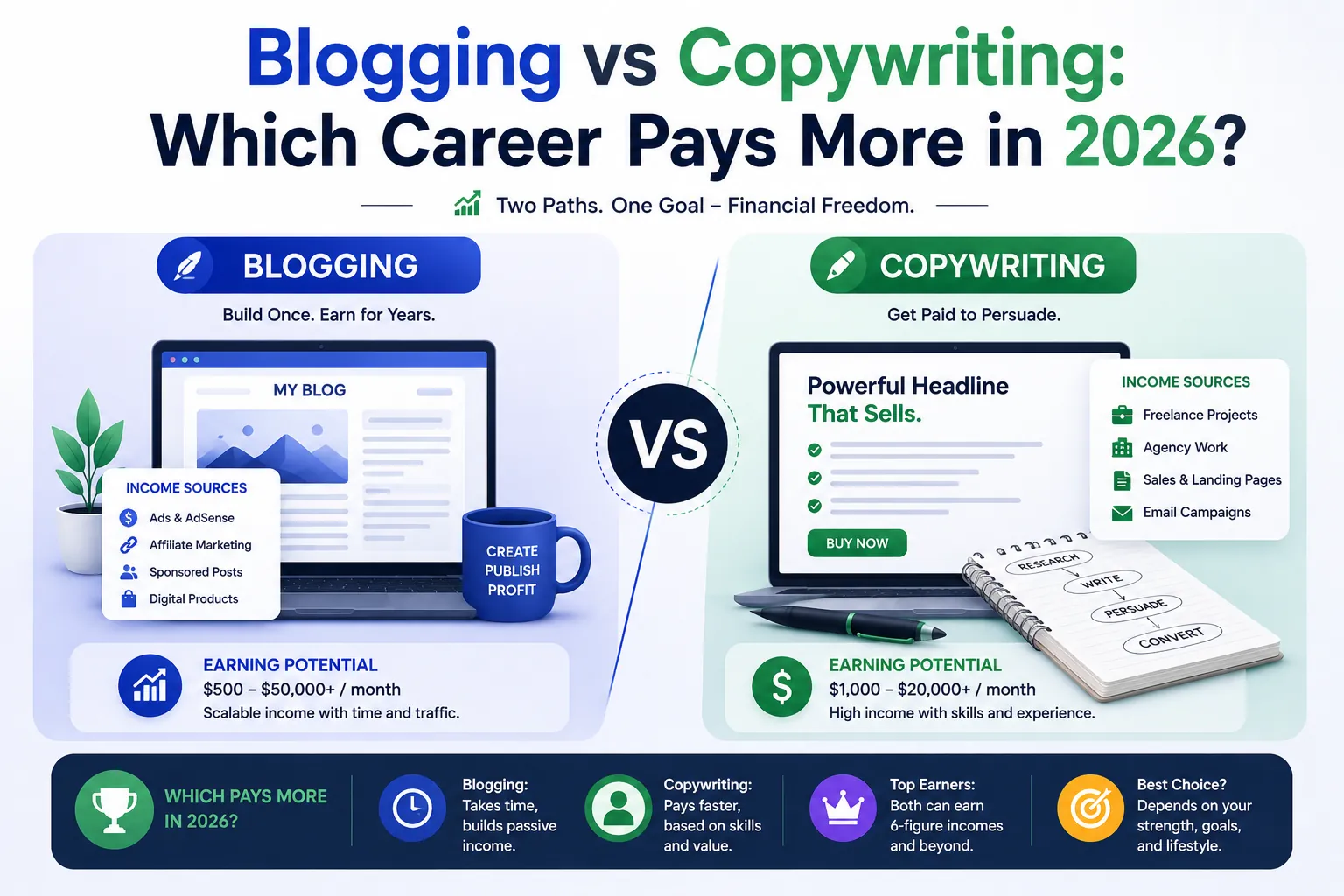
- Blogging vs Copywriting: Which Career Pays More in 2026? - Salary data, freelance rates, and career paths.
- SEO Content Writing vs SEO Copywriting: Which Converts Better in 2026? - Conversion benchmarks and funnel positioning.
- Informational vs Transactional Content: Which Ranks Faster in 2026? - Time-to-rank data and AI Overview patterns.
- Pillar Pages vs Blog Posts: Which Builds Topical Authority Faster in 2026? - Traffic growth case studies and internal linking impact.
- Guest Posting vs Owned Content: Which Builds Authority in 2026? - Backlink value versus owned audience ROI.
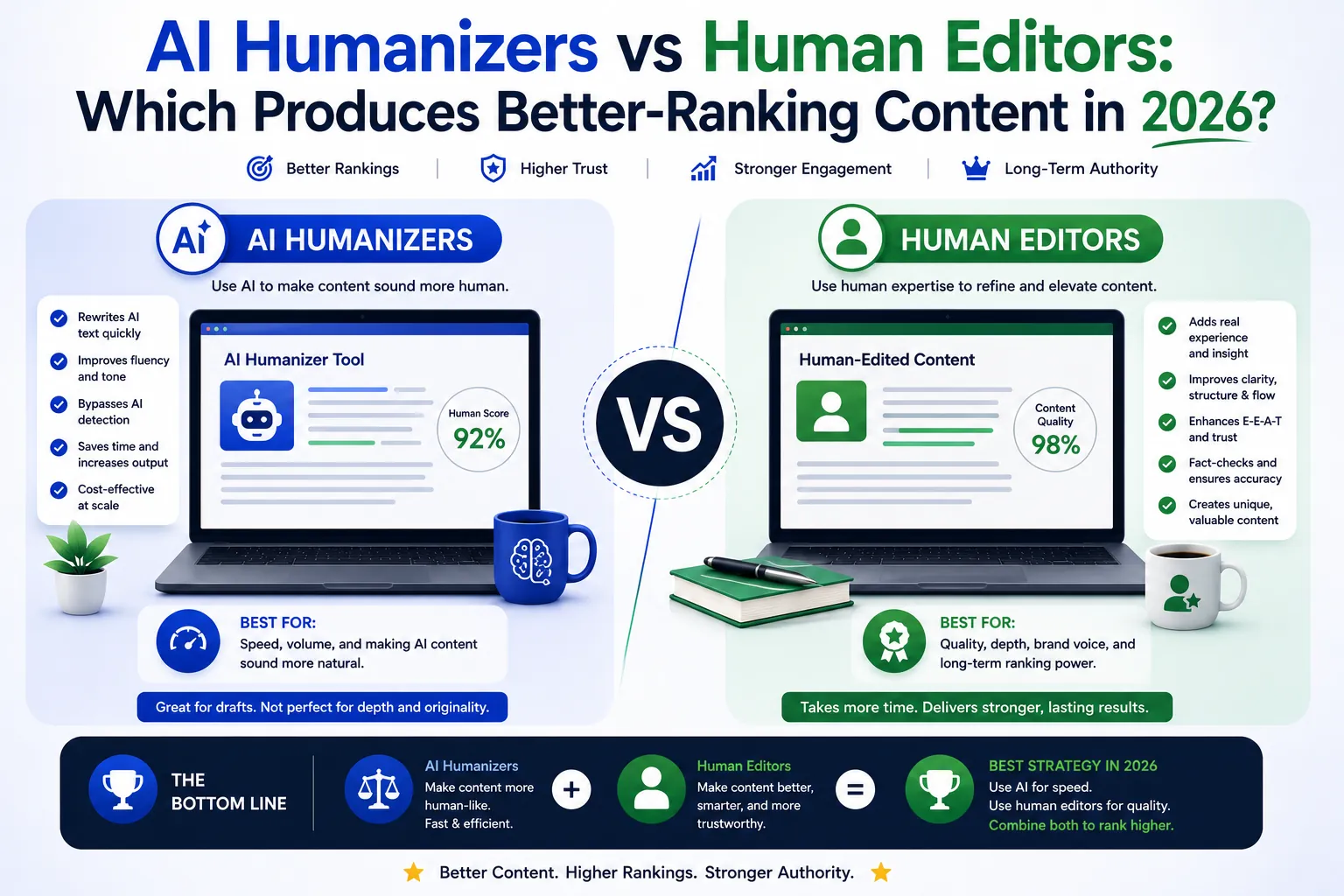
- AI Humanizers vs Human Editors: Which Produces Better-Ranking Content in 2026? - Ranking test results and quality thresholds.
How to Choose: Which Should You Invest In First?
The right starting point depends on your business stage and current gaps.
If you have no audience and no traffic: Start with SEO-driven content writing. Publish pillar pages targeting informational keywords your buyers actually search. Distribution comes from search, not from a following you do not have yet. Our Generative Engine Optimization guide covers how to structure this for both Google and AI search.
If you have traffic but low conversions: Invest in copywriting. Your content brings visitors, but your landing pages and CTAs do not convert them. A/B test your demo request page, pricing page, and email sequences.
If you have conversions but slow growth: Build a content marketing program with an editorial calendar, topic clusters, and multi-channel distribution. SEO alone will not build a brand. Content marketing is what turns one-time buyers into advocates.
If you have a team but no clarity: Audit your current output against this framework. Identify which disciplines are missing or underfunded. Most B2B teams discover they are over-invested in content writing and under-invested in copywriting and SEO.
| Your Situation | Start With | Why |
|---|
| No traffic, no audience | SEO + Content Writing | Search is the only free distribution channel at zero audience |
| Traffic but low conversions | Copywriting | You are paying to bring visitors who leave without acting |
| Steady but not scaling | Content Marketing | You need a strategic program, not piecemeal publishing |
| Team exists, no clarity | Cross-discipline audit | You need to see which gaps are bleeding budget |
The Hybrid Model: Why Top SaaS Brands Use All Four
A Princeton University and KDD 2024 study by Aggarwal, Das, and colleagues tested nine content tactics across 10,000 queries and found that pages combining original data, cited sources, and expert quotations earned the highest citation rates across both Google and AI search engines. Adding citations to sources produced a 40% lift in AI citations. Adding statistics produced a 37% lift. Adding expert quotations produced a 30% lift. These three tactics represent the hybrid model in practice: content marketing produces the data, SEO distributes it, copywriting frames it for conversion, and content writing executes the prose.
The brands that dominate organic search in 2026 apply this model systematically.
HubSpot built a $1B+ business on content marketing. But their SEO team drives the keyword research that informs their content calendar. Their copywriters optimize the landing pages that convert blog readers into CRM trials. Their content writers produce the guides and templates that keep those pages ranking.
Ahrefs does the same. Their blog (content writing) drives organic traffic (SEO). Their product landing pages (copywriting) convert that traffic into paid subscribers. Their email sequences (copywriting + content marketing) retain those subscribers month over month.
The model works because each discipline amplifies the others. SEO sends traffic to content written by content writers. That content builds authority that makes SEO easier. Copywriting converts a fraction of that traffic into revenue that funds more content production. Content marketing creates the email subscribers and brand advocates who distribute the content without paid promotion. Break that cycle at any point and the system stalls.
What This Means for Your 2026 Strategy
The single biggest mistake B2B teams make is treating these four disciplines as interchangeable. They hire a “content person” and expect SEO, copywriting, and content marketing to come as free add-ons.
They do not.
Each discipline requires dedicated expertise, separate KPIs, and its own budget line. A content writer who produces excellent blog posts is not automatically qualified to write a high-converting landing page. An SEO specialist who drives traffic is not responsible for what happens after the visitor arrives.
The teams that win in 2026 are the ones that separate these roles clearly, then build workflows that connect them.
FAQ
What is the difference between content marketing and content writing?
Content marketing is the strategy. Content writing is the execution. Content marketing decides what to create, for whom, and how to distribute it. Content writing produces the actual text.
Can one person do all four?
Rarely well. A generalist can manage content marketing strategy and oversee content writers, but deep SEO technical work and high-conversion copywriting are specialized skills. Most B2B teams under-invest in copywriting because they assume their content writers can handle it.
Which discipline has the highest ROI?
It depends on your stage. For early-stage companies with no traffic, SEO-driven content writing produces the highest ROI. For companies with traffic but low conversion rates, copywriting wins. Content marketing has the longest time to ROI but the highest ceiling.
Is copywriting more important than SEO in 2026?
No. They serve different funnel stages. SEO brings visitors. Copywriting converts them. Losing either creates a leaky funnel.
How has GEO changed these four disciplines?
GEO (Generative Engine Optimization) adds a new distribution layer. Content now needs to earn citations in AI-generated answers, not just rankings in traditional search results. Our guide on GEO vs SEO vs AEO explains how all three interact in 2026.
Download the Free Framework
Get a one-page PDF cheat sheet of the decision framework from this guide. It includes the budget allocation table, the funnel map, and the discipline comparison table.
Download the 4 Disciplines Cheat Sheet
Need help figuring out which discipline your team is missing? Contact Clienvora for a free marketing audit. We map your current content operations against this framework and tell you exactly where the gap is.
This guide was written by Amir Ali, founder of Clienvora. With four years of experience in SEO content writing and conversion copywriting for B2B and e-commerce clients across the USA and UAE, he has built 180K monthly organic visitors for a single brand and published 500+ pieces across six industries. Connect on LinkedIn or view his portfolio.